
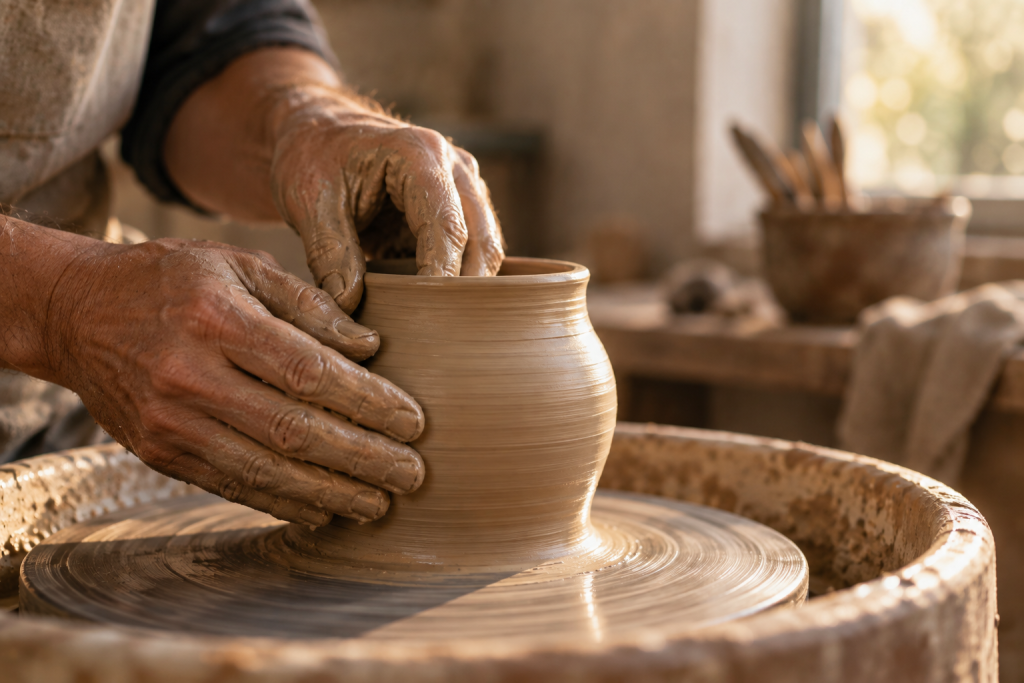
Have you ever watched a potter work with clay? Or have you ever tried to make pottery?
Admittedly, I am truly NOT good at crafts or artwork, so my pottery wasn’t much to behold, but it taught me something.
The clay spins while the potter’s hands press, pull, smooth, and shape it.
Sometimes pressure comes from the outside.
Sometimes a hand reaches inside the vessel.
Then what appeared to be taking shape is pressed down and formed again.
The clay doesn’t know what the Potter knows. It cannot see the finished vessel. It simply has to remain moldable.
A Picture of Humility
I wonder if that gives us a picture of humility. I have been covering the lovely topic of the roots of offense this month.
Yeah, no one probably wants to touch that topic with a 10-foot pole, but when offenses are dividing people, we MUST talk about it and seek to find how Christ handled it.
Last week, we talked about bitterness—what can happen when hurt takes root. This week, we’re looking at another root: pride. Ouch.
But rather than simply talking about how to root out pride, I want to focus on what God wants to grow in its place.
Humility.
A Posture of Humility
We sometimes think humility means thinking poorly of ourselves, minimizing our gifts, or allowing other people to walk all over us.
C.S. Lewis was thought to have said that “Humility is not thinking less of yourself, but thinking of yourself less.” But Rick Warren actually said this in his book, The Purpose Driven Life.
Nonetheless, I think this definition of humility is still wanting. If humility could be achieved by merely thinking a little less about ourselves, that does not come close to the humility Christ exemplified.
We try to make something of ourselves, and Christ sought to make Himself nothing. “Instead he emptied himself by assuming the form of a servant, taking on the likeness of humanity” (Philippians 2:7).
Ultimately Christ’s humiliation became His exaltation.
A Portrait of Humility
Christ showed us that humility is recognizing that God is the Potter and we are the clay.
Isaiah says:
“Yet Lord, you are our Father; we are the clay, and you are our potter; we all are the work of your hands” (Isaiah 64:8).
What freedom there is in remembering that.
We don’t have to have everything figured out, be right all the time, or prove ourselves.
We don’t have to defend every criticism or compare our vessel with someone else’s.
Instead, we just have to remain soft in the Potter’s hands, submitting to His will.
Humility stays moldable.
When Pride Hardens the Clay
Clay must remain workable in the hands of the potter. Once it hardens, reshaping becomes difficult. Our hearts can become hardened too.
Pride says: I already know. That’s just who I am. They’re the problem. I don’t need correction. I shouldn’t have to apologize.
Why did they get that opportunity instead of me? Don’t they know who I am?
And this is where pride and offense often meet. Sometimes what hurts isn’t merely what someone said or did. It’s what their actions seemed to threaten.
Our reputation, position, competence, importance, or the need to be right or treated a certain way.
Pride makes every wound feel like a throne was threatened. Humility remembers that the throne was never ours.
God is God.
We are His workmanship.
A Pattern of Humility
Rather than defending ourselves against every uncomfortable pressure, we can ask:
“Lord, are You using even this to shape me?”
When we look at the roots beneath some of our offenses, we might ask a different question:
Why do some things offend us so deeply?
Sometimes the answer is simple. We were genuinely hurt. Maybe someone sinned against us, treated us unfairly, or said something cruel.
But sometimes something else lies beneath the hurt. We felt threatened. And that’s where pride can quietly enter the story.
Paul writes:
“Do nothing out of selfish ambition or conceit, but in humility consider others as more important than yourselves. Everyone should look not to his own interests, but rather to the interests of others. Adopt the same attitude as that of Christ Jesus” (Philippians 2:3–5).
I love that Paul doesn’t merely give us a command.
He gives us a Person: Jesus.
Jesus knew exactly who He was.
His humility did not come from insecurity.
It came from security.
He didn’t have to prove His importance because He knew His identity.
He didn’t have to grasp for position because He knew His Father.
Jesus could stoop because He wasn’t afraid of becoming small.
Perhaps that’s where our understanding of humility needs to begin.
Humility isn’t insecurity. It is security in Christ that no longer needs to prove itself. And that kind of humility brings tremendous freedom.
5 Ways Humility Shapes Us
1. Humility Remains Teachable
One of the clearest marks of humility is teachability.
Proverbs 15:31 says: “The one who listens to life-giving rebukes will be at home among the wise.”
Notice that wisdom isn’t demonstrated by never needing correction. Wisdom is demonstrated by being willing to receive it. That changes the way we experience criticism.
Instead of immediately asking: “How do I defend myself?”
We can ask: “Lord, is there something here You want me to hear?”
Not every criticism is accurate. And every person’s assessment of us is true. Humility doesn’t require us to accept false accusations.
But it does let us examine what is said without feeling our identity is threatened.
If it’s true, we can receive it. If it isn’t, we can release it.
Humility stays soft enough for God to keep shaping us.
2. Humility Doesn’t Have to Prove Itself
Jesus gives us the ultimate picture of this.
Paul writes: “Adopt the same attitude as that of Christ Jesus” (Philippians 2:5).
Jesus knew exactly who He was. And because He knew who He was, He didn’t have to prove it.
Philippians 2 tells us that although He existed in the form of God, He took the form of a servant and humbled Himself.
His humility didn’t come from insecurity. It came from security. The same can be true for us.
When our identity is rooted in Christ, we don’t have to spend our lives proving our worth or trying to win every argument. We don’t have to make sure everyone understands us. And we don’t have to announce every accomplishment or correct every false impression.
Humility isn’t insecurity. It is security in Christ that no longer needs to prove itself.
3. Humility Allows Pressure to Produce Growth
Anyone who has watched pottery being shaped knows that pressure is part of the process.
Without pressure, the clay remains a lump. The potter’s hands apply pressure precisely because he sees what the clay can become.
Could God use some of the pressures we resist to shape us too? The difficult relationship. Criticism. Disappointment. The closed door. That person who gets under our skin. Maybe even a season when no one seems to notice what we’re doing.
We shouldn’t assume every painful circumstance came from God. We live in a broken world, and people genuinely sin against one another.
But nothing that reaches us is beyond God’s ability to redeem and use.
What if instead of only asking, “God, why is this happening?”
We also asked, “God, how do You want to shape me through this?”
The pressure might reveal pride, impatience, a need for approval, comparison, control, self-reliance.
And suddenly the thing we wanted God to remove becomes something He uses to reveal where He wants to transform us.
The Potter doesn’t waste the pressure.
4. Humility Stops Comparing Vessels
Imagine clay on the potter’s wheel looking over and saying:
Why don’t I look like that vessel?
Why is theirs bigger?
How come they get that design?
Why are they already finished?
It sounds ridiculous.
And yet we do this all the time.
We compare callings.
Platforms.
Families.
Bodies.
Careers.
Ministries.
Opportunities.
Gifts.
Timelines.
But the Potter isn’t making identical vessels.
Ephesians 2:10 reminds us: “For we are his workmanship, created in Christ Jesus for good works, which God prepared ahead of time for us to do.”
Someone else’s calling isn’t evidence that yours is insignificant.
Someone else’s blessing isn’t evidence that God has overlooked you.
And someone else’s season doesn’t tell you what God is doing in yours.
Humility can celebrate another vessel because it trusts the Potter with its own design.
5. Humility Lets the Potter Decide What Needs to Change
Perhaps this is the hardest part. We usually have strong opinions about what God should change.
Change them. Change this situation. Open this door. Remove this obstacle. Fix this relationship. And sometimes God does.
But sometimes, while we’re asking God to change everything around us, the Potter puts His hands on us.
Maybe the transformation we’re asking for begins in our own hearts.
David prayed: “Search me, God, and know my heart; test me and know my concerns. See if there is any offensive way in me; lead me in the everlasting way” (Psalm 139:23–24).
That’s a humble prayer.
It says: “God, before I ask You to show me what’s wrong with everyone else, show me what You want to shape in me.”
That’s not condemnation. That’s discipleship.
What freedom there is in becoming a person who doesn’t have to be finished yet.
We can be corrected. We can change, apologize, learn, grow, and admit that we were wrong.
Because the Potter isn’t finished with us.
Mindset Reset
This week, instead of only asking what is wrong with the people or circumstances frustrating you, ask:
“Lord, how are You shaping me through this?”
Is there somewhere you’ve become resistant to His hands?
A correction you don’t want to hear?
An apology you don’t want to make?
Maybe a comparison you need to surrender?
Or a reputation you’re exhausting yourself trying to protect?
Maybe even a situation you desperately want God to change when He may first want to change something in you?
Place it back on the wheel.
And remain soft.
Because humility isn’t thinking less of yourself. It’s trusting the Potter enough to let Him keep working.
You don’t have to prove anything, look like another vessel, or even have to understand everything the Potter is doing. You just need to remain moldable in His hands.
Pride says, “I know what I should be.”
Humility says, “God, make me what You want me to be.”
And perhaps that’s the greatest freedom humility gives us:
We can stop trying to shape ourselves and surrender to the One who already sees the finished work.
Prayer
Father, You are the Potter, and I am the clay. Forgive me for the places where pride has made my heart resistant to Your hands. Keep me soft and teachable before You. When correction comes, help me listen. When pressure comes, help me trust You. And when someone else is blessed, help me celebrate instead of comparing. When I want to defend, prove, or promote myself, remind me that my identity is already secure in Christ. Search me, shape me, and remove anything that keeps me from reflecting Jesus. I don’t need to control what You are making of my life. I simply want to remain moldable in Your hands. In Jesus’ name, Amen.
Humility stays soft in the Potter’s hands.
Visit the Shame Rx Blog for this week’s post, The Freedom of Being Teachable.
All for Jesus,
Denise